“Read My Lips, Not My Body”: Autistic Perspectives on Communicating with (non-)Autistic People
Abstract
Background
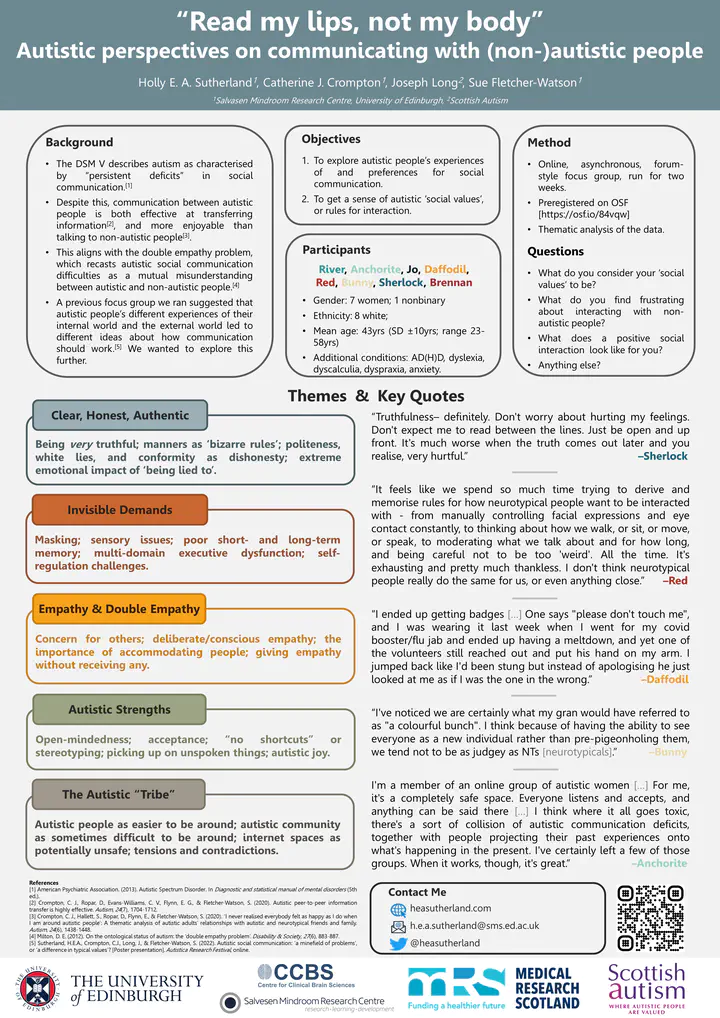
Existing literature on social communication in autism primarily focuses on the communication difficulties between autistic and non-autistic people, presenting this as an autistic ‘impairment’. However, recent research – which has found highly successful social communication between autistic people – suggests this may not be an accurate framing. Instead, it may be that autistic people have a communication style that is incompatible with non-autistic people’s, but compatible with other autistic people’s.
What features might define this communication style, and what might cause the differences between it and a non-autistic one, are currently unclear. Improving our understanding of this autistic communication style may help improve communication between autistic and non-autistic people.
Objectives
Primarily, to explore autistic people’s experiences of social interaction and communication, and their preferences for this – with a focus on differences between interactions with other autistic versus non-autistic people. Secondarily, to gather autistic feedback on a list of ‘autistic social values’ derived from the thematic analysis of a previous, similar focus group.
Methods
10 autistic adults (9W, 1NB; mean age = 43, range = 23-58) without intellectual disabilities took part in an online, forum-style focus group for two weeks. The primary topics were: (1) what people consider their ‘social values’ to be (e.g. their rules/expectations around communication), (2) what they found frustrating about interacting with non-autistic people, (3) what ‘positive social interactions’ looked like for them, (4) anything else they wanted to say on the topic, and (5) thoughts/opinions on a list of ‘autistic social values’ produced by the researcher from a previous focus group. The fifth topic was introduced a week into the group, to minimise influence on other responses.
Results
Thematic analysis of the focus group produced the following indicative themes:
Managing Social Energy: autistic people often have limited social energy, and managing/rationing this in social situations can be challenging.
Sources of Anxiety: there are many sources of anxiety for autistic people in social interaction, including transitions, uncertainty, the risk of upsetting or offending people, or being bullied.
Frustrations with Non-Autistic People: non-autistic people’s insistence on doing things a certain way, and inability to consider autistic perspectives, is frustrating.
Differences in Empathy: things that may be kind and empathic from a non-autistic perspective may not be from an autistic perspective. There is a mutual lack of understanding.
Importance of Community: being around other autistic people is important for self-understanding and wellbeing.
Conclusions
Autistic adults have different expectations and desires around social interaction and communication. This is driven, at least in part, by different social, communicative, and emotional needs. These differences can make interacting with non-autistic people difficult and stressful for autistic people, and contribute to miscommunication between neurotypes. More work is needed to fully understand a) what defines the autistic communication style, and b) how to best bridge the gap between autistic and non-autistic communication styles.