An (auto)ethnographic study of the double empathy problem in social care services for autistic people with high support needs
Abstract
Background:
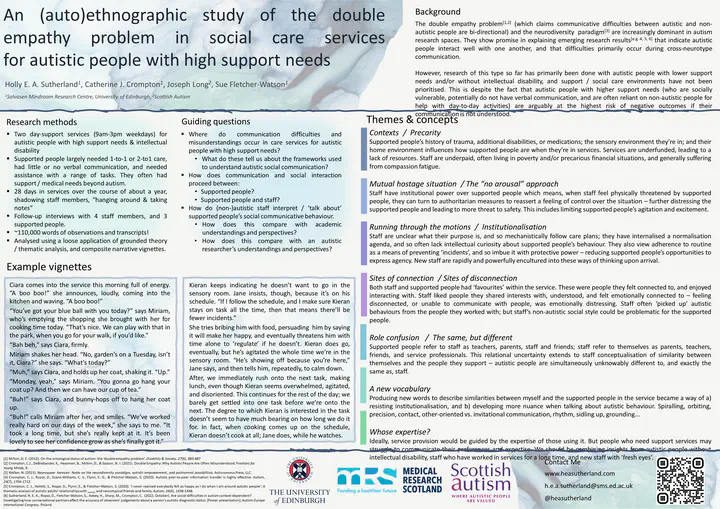
Applying the double empathy problem to autistic social communication has led recently to intriguing empirical results. However, most of this research has involved autistic people with relatively low support needs, greater autonomy, and more normative communication. Despite assumptions that the double empathy problem is applicable to autistic people with higher support needs, there is currently a lack of supporting evidence for this.
Given the growing interest from the social sector in ‘neurodiversity-affirming care’, there is clearly an urgent need for research examining the relevance of the double empathy problem to service provision for autistic people with higher support needs. To this end, we undertook an ethnographic study involving autistic people with higher support needs and staff in a social care setting.
Objectives:
To apply a double empathy lens to understanding interactions between social care practitioners and autistic people with high support needs.
To use (auto)-ethnographic methods to investigate the applicability (and potential value) of insights from autistic people with lower support needs to support and care provision for autistic people with higher support needs.
Methods:
We used a flexible range of Qualitative methods: participant observation, interviews, and autoethnographic reflections by the (autistic) ethnographer. Participant observation took place at two day-support services for autistic adults with high support needs. The ethnographer undertook multiple visits to each site, for 3-5 days at a time. Interviews took place at one service, at the end of the observation period. Autoethnographic reflection was ongoing throughout. The resulting data were analysed using Grounded Theory.
Results:
Several categories emerged from the data, including:
- Similarities between autistic adults with higher and lower support needs, both as experienced by the ethnographer and autistic staff, and as commented on by non-autistic staff.
- A view of autism by staff that varied between “just like us” and “very unlike us” dependent on the specific scenario and the explanatory convenience of the view.
- Non-autistic staff’s desire to connect with and understand the autistic adults, their valuing of autistic staff’s input into understanding the autistic adults’ lived experience; but frequent difficulty by staff of understanding autistic experiences around sensory differences, stimming, desire for routine, and the excitement/anxiety continuum.
- Rich and complex social dynamics between the staff and autistic adults, that are not well explained by a ‘social deficit’ view of autism.
- Neurodiversity-unrelated institutional challenges such as: difficulty providing continuity of care, the lasting harm of previous care environments on the autistic adults, and the ongoing challenging of managing workplace and home-life emotional labour for staff.
Conclusion:
Non-autistic staff (despite training in autism and in providing care to autistic people) can struggle to understand autistic sensory experiences, and to interpret autistic behaviour and autistic communication styles. Autistic people (including staff and researchers) sometimes have a specific insight into the needs and behaviours of the supported autistic people, due to shared autistic experiences (regardless of support needs). Such insights are valuable for their potential in helping bridge the double empathy gap in support services.